
Freelancing in digital marketing is one of the easiest and most flexible ways to earn money online in today’s digital world. As more and more businesses are launching online, there is a huge demand for talented digital marketers to market brands, manage social media, run ads, and increase online visibility.
However, most beginners fail because they want to learn too many skills at once, or they start without a clear direction. So, the smart way to start freelancing in digital marketing is to take a simple and practical path. Choose one skill, build real experience through practice, create a portfolio and slowly work with clients. This method is designed to save time, prevent confusion and help beginners lay a solid foundation for a successful freelancing career in the digital marketing industry.
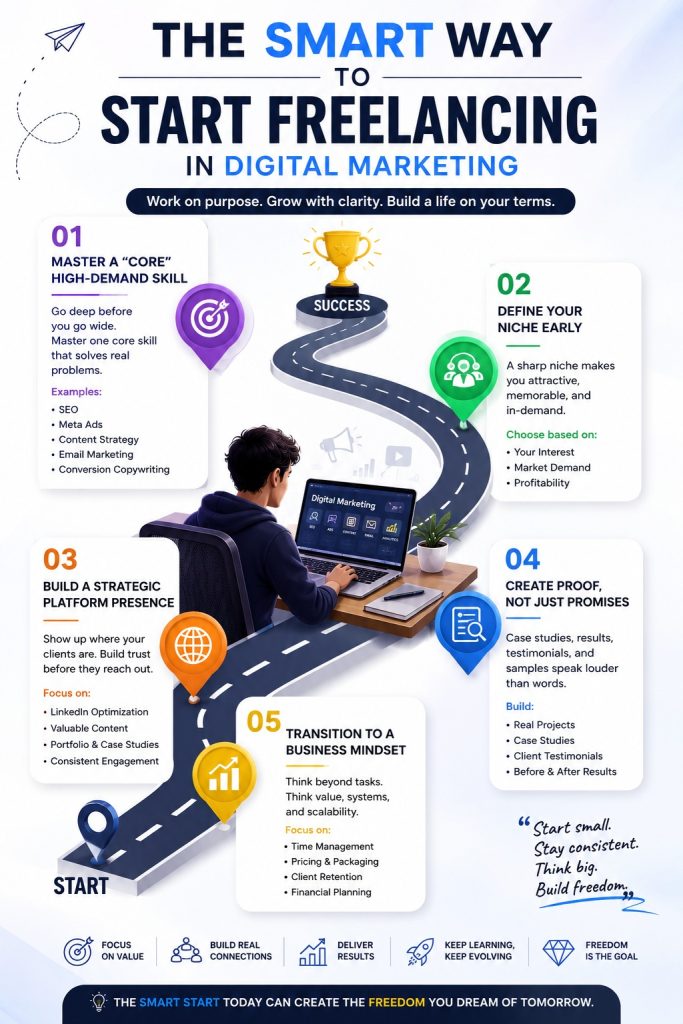
“5 Smart Steps to Build a Successful Freelancing Career in Digital Marketing”
1 Master a “Core” High-Demand Skill

Mastering a core high-demand skill means that instead of trying to learn many skills at once, you focus on learning and becoming highly proficient in one specific digital marketing skill that is in high demand in the market, such as SEO, social media marketing, content writing, or paid advertising.
This means that you need to build deep expertise by continuously practicing, working on real projects, and constantly improving, so that you can confidently offer professional services and solve real client problems in that specific area.
2 Define Your Niche Early

Defining your niche early means you will be serving a specific specialized segment of the market at the beginning of your freelancing career. You don’t try to be a “generalist” who offers every digital marketing service to everyone. Instead, you specialize in a particular industry (real estate, e-commerce, healthcare, etc.) or a particular type of service (Email Marketing for SaaS, TikTok Ads for beauty brands, etc.). It’s much quicker to become an expert in one thing than to try and master everything at once. You can customize your portfolio and messaging to address the pain points of a specific set of clients. Specialists are almost always paid more than generalists because they offer “expert” solutions, not “basic” services.
3 Build a “Proof-First” Portfolio
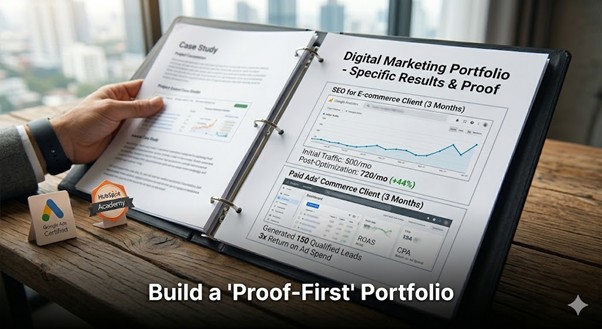
Developing a “proof-first” portfolio involves emphasizing concrete proof of your results and technical competence, not just a list of services or certificates. In the digital marketing world, clients care less about what you say you can do and more about what you have done. By focusing on “proof” first, you immediately validate to prospective clients that you are a low risk, high reward investment. Short summaries of the problem you solved, the approach you took, and the specific result you achieved (e.g. “Increased organic traffic 20% in 3 months”). Direct links to blogs you’ve written, social media accounts you’ve managed, or websites you’ve optimized. Ad dashboard screenshots (with sensitive information blurred), content calendars, or high performing creative assets.
4 strategic Platform Presence

Strategic platform presence means you select the right online platforms—like freelancing sites and social media—and use them deliberately to display your skills, attract clients, and establish credibility.
Instead of trying to be everywhere, you focus on the platforms your target clients spend the most time on (Upwork, Fiverr, LinkedIn, Instagram, etc.) and optimize your profile, content, and activity to bring in freelance digital marketing opportunities. Platform Selection: Pick channels where your target audience is already present (e.g., LinkedIn for B2B networking or TikTok for Gen Z consumer products). Adapting the format and tone of your content to be appropriate for the “culture” of the platform but maintaining your brand voice.
5 Transitioning to a Business Mindset
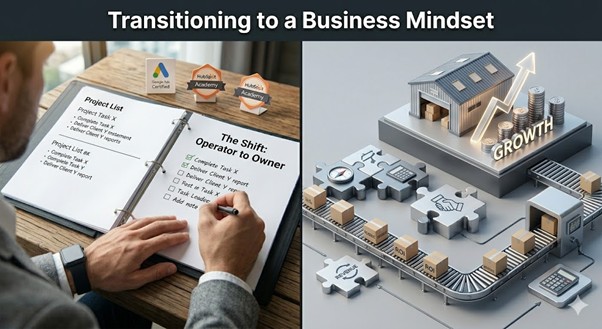
Transitioning to a business mindset is the psychological and operational shift from being a technical executor (the person doing the work) to a strategic owner (the person driving the value).
It involves moving away from focusing solely on tasks and instead focusing on outcomes, scalability, and market positioning. Instead of asking, “How do I complete this project?” a business mindset asks, “How does this project generate ROI for my client or company?” * The 80/20 Rule (Pareto Principle): Identifying the 20% of activities that drive 80% of the results. This mindset requires letting go of perfectionism in minor details to focus on high-impact growth.
Shifting from “avoiding mistakes” to “calculating risks.” Business owners understand that some failure is a cost of innovation, provided the potential upside is significant.
CONCLUSION
The transition from a beginner to a successful freelance digital marketer isn’t about how many tools you can use, but about the specific value you can provide. By mastering a single high-demand skill, narrowing your niche, and leading with a “proof-first” portfolio, you move from being a replaceable service provider to an indispensable business partner. Ultimately, the “smart way” is to stop chasing every trend and start building a structured business. When you combine a strategic platform presence with a mindset focused on client ROI, you create a career that offers more than just flexibility—it offers long-term financial growth and professional authority in an ever-evolving digital landscape. Success in freelancing isn’t found in doing everything; it’s found in being the best solution for a specific problem.